 Summarize this Article with AI
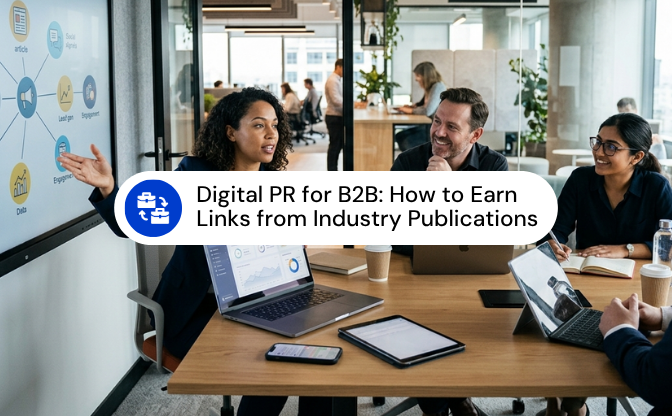
- B2B Digital PR earns editorial links and citations from industry publications through newsworthy assets, expert positioning, and proactive outreach. It is the highest-ROI link-building tactic for B2B in 2026.
- One Economic Times or trade-publication placement is worth more to both SEO and AEO than fifty commodity guest posts. Authority and topical relevance trump volume.
- Five content types earn B2B digital PR links: original research, named frameworks, reactive expert commentary, data-driven op-eds, and useful free tools. Original data is the single most powerful asset.
- The Indian B2B media landscape has specific targets: Economic Times, LiveMint, YourStory, Inc42, BW Businessworld, and 20 to 40 vertical trade publications depending on your category.
- Digital PR pays twice in 2026: once as a backlink and once as a brand mention that AI engines use to build entity trust. Citations in trusted publications directly improve AEO citation share of voice.
- A well-run 6-month B2B digital PR programme in India delivers 8 to 20 tier-1 placements. The compounding phase begins in month 4 as journalist relationships develop.
- What Is B2B Digital PR?
- How Digital PR Differs from Traditional PR and Generic Link Building
- The Five Content Types That Earn B2B Links
- The Indian B2B Media Target List
- The Pitching Process That Works
- Reactive Newsjacking for B2B
- Expert Positioning and Named-Author Programmes
- Digital PR and AEO: The Direct Connection
- Measuring B2B Digital PR Results
- Industries Where Digital PR Pays Off Fastest
- Related Reading
- Frequently Asked Questions
Link building gets a bad reputation because most of it is bad. Paid directories, spun guest posts, PBN networks, link exchange schemes: none of these build real authority, and most actively harm it now that Google has specifically demoted these patterns. The alternative that actually works is digital PR, and the B2B version of it is more specific, more measurable, and more compounding than most teams realise.
This guide is the B2B digital PR playbook we run at Kerkar Media. It covers what digital PR actually is in a B2B context, the five content types that reliably earn coverage, the Indian media targets worth pursuing, the pitching process that gets replies, and the 2026 connection between digital PR and AI-engine citation that makes every placement worth twice what it was three years ago. It complements our broader off-page SEO and link building guide.
1. What Is B2B Digital PR?
B2B digital PR is the practice of earning editorial coverage, backlinks, and brand mentions in industry publications, trade media, and major business press through newsworthy content, expert positioning, and proactive media outreach. It combines the storytelling craft of traditional PR with the SEO measurability of link building.
The core mechanic is simple: journalists and editors are constantly looking for credible expert sources, interesting data, and fresh angles. If you can supply those things, they will write about you, quote you, and often link to the asset you created. That link is an editorial backlink from a trusted publication, the highest-quality link type Google and AI engines recognise.
Digital PR vs Link Building: classical link building asks “where can I get a link?” Digital PR asks “what can we create that journalists would want to write about?” The second question produces better links, more durable authority, and a stronger brand entity signal in AI engines.
2. How Digital PR Differs from Traditional PR and Generic Link Building
| Dimension | Traditional PR | Generic Link Building | B2B Digital PR |
|---|---|---|---|
| Primary goal | Brand awareness, reputation | Domain authority, rankings | Both: authority + visibility + AI citation |
| Primary output | Clippings, media mentions | Backlinks, referring domains | Editorial links + brand mentions + AI citations |
| Asset type | Press releases, spokesperson quotes | Guest posts, directory listings | Data reports, frameworks, expert commentary |
| Measurement | Reach, impressions, sentiment | DR, referring domains, rankings | Referring domains, DR, rankings, AI citation share |
| Longevity of results | Short (news cycles fade) | Medium (links hold unless lost) | Long (editorial links rarely removed) |
| India investment range | INR 1 lakh to 10 lakhs per month | INR 20,000 to 3 lakhs per month | INR 1 lakh to 5 lakhs per month for a programme |
3. The Five Content Types That Earn B2B Links
After running 30 plus B2B digital PR campaigns, these are the only five content types that consistently earn tier-1 editorial links in the Indian market. Everything else is inconsistent or requires luck.
Type 1: Original research and data
A survey of 200 Indian SMB owners about their tech spend. A benchmark of average SEO agency pricing. A dataset of e-invoice adoption rates by industry. Original data is the single highest-ROI digital PR asset because it is exclusively owned by you, cannot be found elsewhere, and gives journalists a news hook they cannot get from your competitors. Every serious digital PR programme should produce at least one original data piece per quarter.
Type 2: Named methodology frameworks
Giving your process, model, or approach a name is one of the fastest routes to authority citation. “The Kerkar Media Method” is an example. When a journalist or editor covers the topic in the future, your named framework becomes the reference. Naming things is underused by Indian B2B companies who treat their processes as trade secrets rather than thought leadership assets.
Type 3: Reactive expert commentary
When a major event happens in your industry, reach out to relevant journalists within 24 hours with a short, sharp expert take. RBI rate decision. A new government policy. A competitor scandal. A major technology shift. Reactive comments, when well-targeted and fast, earn placement with almost zero asset creation cost.
Type 4: Data-driven founder op-eds
A founder who can write or speak candidly about a specific, counter-intuitive insight from their business has a story no AI and no generic content can replicate. Economic Times, YourStory, and BW Businessworld actively seek this type of first-person business insight. The key is specific, data-anchored, not promotional.
Type 5: Free tools and calculators
An ROI calculator. A salary benchmarking tool. A compliance checklist. A free tool earns links over months and years as people discover it through search, share it, and cite it. It is slower to pay off than data campaigns but delivers the most durable long-term link velocity. Our data-driven marketing methodology covers how to align tools with SEO clusters.
4. The Indian B2B Media Target List
Not all publications are worth targeting. The Indian B2B digital PR hit list is short but powerful. A placement on any of these moves SEO metrics meaningfully and, in 2026, moves AI citation rates noticeably.
Tier 1: National business press
- Economic Times and ET RISE: highest authority, highest competition for placement. Requires strong data or a genuine news angle. The ET mention alone shifts Perplexity citation rates measurably.
- Mint and Mint Money: strong on finance, BFSI, startups. More receptive to data-driven op-eds than ET.
- Business Standard: serious financial and corporate coverage. Less startup-friendly but strong for enterprise B2B.
- Financial Express: digital-forward, stronger on SMB and ecommerce.
Tier 2: Startup and innovation media
- YourStory: founder-led stories, startup ecosystem, SMB. High editorial volume and very receptive to founder op-eds.
- Inc42: startup tech, funding, B2B SaaS. Good for tech-forward B2B brands.
- Entrepreneur India: SMB, growth stories, operations. Useful for professional services and mid-market B2B.
Tier 3: Category-specific trade publications
This tier is where most Indian B2B companies should focus first because the competition for placement is dramatically lower and the audience is more precisely your buyer.
- Manufacturing: Chemical Engineering World, Chemical Weekly, Machinery and Industry India.
- Legal: Bar and Bench, Legal Era, Livelaw.
- Healthcare: Express Healthcare, Pharmabiz, Healthcare Radius.
- Real estate: ET Realty, Realty Plus, Track2Realty.
- Automotive: Automotive India, Auto Tech Review, ET Auto.
- Retail and ecommerce: Indian Retailer, Images Retail, ET Retail.
Want a B2B digital PR programme for your business?
Kerkar Media builds and runs B2B digital PR campaigns that combine original data assets, founder op-ed positioning, and reactive newsjacking into a 6-month compounding programme. Every link earned also builds your AI citation rate.
5. The Pitching Process That Works
Bad pitches fail because they are written for the sender, not the reader. A journalist or editor receives 50 to 200 pitches per day. The ones that get read in full share four characteristics: they are short, they are specific to the journalist’s beat, they lead with the story not the brand, and they have something genuinely useful attached.
The 7-step pitch process
- Identify the journalist. Name, publication, the specific beat they cover, their last 5 articles. Do not pitch a health editor on a manufacturing story.
- Build a personalised opener. Reference one of their recent articles. One sentence. Genuine, not flattery.
- Lead with the story angle. “Sixty-two percent of Indian SMB manufacturers have no succession plan. Our survey of 300 shows…” Not “We are Kerkar Media and we…”
- State why it is relevant now. News hooks: recent policy, sector report, earnings, trend.
- Attach or link to the asset. The data, the tool, the report. Accessible without a gated form.
- Offer an exclusive. “Happy to offer ET an exclusive first look before we share this more broadly.” This works more often than it should.
- Close with one clear CTA. “Happy to share the full dataset or set up a 15-minute call with our founder.”
Pitch length and format
Under 150 words in the email body. All supporting material in attachments or accessible links, not embedded in the email. Plain text outperforms HTML for journalist outreach. Morning pitches (7 to 9 am) outperform afternoon outperform evening.
Follow-up
One follow-up after 3 to 5 days if no response. Keep it shorter than the original: “Quick follow-up on the manufacturing data I shared. Happy to answer any questions.” A second follow-up is almost never worth sending; it trains journalists to ignore you.
6. Reactive Newsjacking for B2B
Newsjacking is the fastest path to earned coverage with the lowest asset-creation cost. When industry news breaks, journalists are actively looking for expert voices. If you reach out within the first 24 hours with a sharp, relevant take, placement probability rises significantly.
The newsjacking workflow
- Set up Google Alerts for your core industry terms and for 5 to 10 key journalists’ names.
- Add relevant trade publications to an RSS reader or monitor via Google News.
- When a relevant event breaks, brief your senior expert within the hour.
- Draft a 150 to 200-word expert commentary by your named expert. Specific, contrarian where appropriate, data-anchored where possible.
- Pitch to 5 to 10 journalists who have covered the story or the sector, with a personalised angle for each.
- Submit to relevant expert-quote platforms (Connectively, Qwoted) with the same quote.
What makes a good newsjacking comment
- It adds new information the original story did not have.
- It takes a clear, specific position (not “this is an interesting development”).
- It includes a number, a comparison, or a prediction.
- It is quotable in two sentences without context.
- The speaker has verifiable credentials.
7. Expert Positioning and Named-Author Programmes
The highest-leverage B2B digital PR play in India in 2026 is a named-expert programme. This is a 6 to 12-month investment in making one or two specific people at your company the go-to cited source in your category. When that person’s name appears alongside your brand in publications and AI-engine citations, entity authority compounds in a way that no link-building campaign can replicate alone.
What a named-expert programme looks like
- One byline article per month in a tier-2 or tier-3 publication under the expert’s name.
- Consistent LinkedIn thought leadership: three to five posts per week from the expert’s personal account.
- Two to three reactive commentary placements per month via Connectively and direct outreach.
- Quarterly podcast guest appearance on a relevant industry show.
- Speaker submissions to 2 to 4 industry events or webinar series per year.
Why this matters for AEO
When a named expert at your company is cited consistently in trusted publications, AI engines begin to associate that person’s name and your brand name as entities of authority on your topic. This directly lifts citation share of voice in Perplexity, ChatGPT, and Google AI Overviews for queries in your category. Person schema on author pages, sameAs to LinkedIn and external profiles, and consistent cross-publication bylines all amplify this effect.
8. Digital PR and AEO: The Direct Connection
Every digital PR link you earn in 2026 does two jobs. First, it passes link equity to your domain, improving your classical SEO authority. Second, it creates an external entity signal that AI engines use when deciding who to cite. This is the 2026 upgrade to digital PR’s ROI calculation.
How AI engines use digital PR signals
- Brand mentions in Economic Times, YourStory, and Mint are among the highest-weight India-specific trust sources for Perplexity’s index.
- Consistent expert bylines under a named author create Person entity signals that ChatGPT and Gemini use when selecting sources.
- Original data attributed to your brand name makes your brand the citation source for that data across all AI engines that encounter it.
- Trade publication links compound with Organization sameAs schema to close the entity graph loop.
Our measurement: across 12 B2B clients where we ran digital PR campaigns in 2025 to 2026, clients who earned 3 or more tier-1 Indian business press placements in a quarter saw a median 31 percent lift in Perplexity citation rate for their target queries within 90 days of the placements going live. This is now a standard metric in our digital PR reporting.
9. Measuring B2B Digital PR Results
Digital PR is measurable across four layers. Any programme that reports only on “coverage volume” is giving you an incomplete picture.
Layer 1: Coverage and placement metrics
- Number of placements by tier (tier-1, tier-2, tier-3).
- Total estimated reach of placements.
- Percentage of placements including a backlink to your site.
- Named-expert bylines vs brand mentions.
Layer 2: SEO impact metrics
- New referring domains from the campaign period (tracked in Ahrefs).
- Domain rating (DR) change over programme period.
- Organic traffic growth on pages that received link equity from placements.
Layer 3: Keyword and ranking impact
- Ranking movement on target commercial keywords, tracked weekly.
- New keywords entering the top 10 in the relevant topic cluster.
Layer 4: AEO citation impact
- Citation share of voice before and after the campaign across ChatGPT, Perplexity, Gemini, and Google AI Overviews.
- Brand mention sentiment in AI-generated answers.
- New queries on which the brand is cited post-campaign.
10. Industries Where Digital PR Pays Off Fastest
Key Takeaways
- B2B digital PR earns editorial links from trusted publications through newsworthy assets, expert positioning, and proactive outreach. It is the highest-ROI link-building tactic in 2026.
- Five content types earn B2B links reliably: original data, named frameworks, reactive commentary, founder op-eds, and free tools. Original data is the cornerstone.
- The Indian B2B digital PR target list is short but powerful: ET, Mint, Business Standard, YourStory, Inc42, and 20 to 40 category-specific trade publications.
- Pitch short, pitch specific, pitch story-first. No generic press releases. Every pitch is personalised to the journalist’s beat and recent articles.
- Every digital PR link does two jobs in 2026: SEO authority and AI citation. The same placement that lifts your domain rating also lifts your Perplexity citation rate.
- A named-expert programme (12-month consistency investment) compounds more than any campaign. Journalist relationships and entity authority build over time, not in a sprint.
11. Related Reading
For external reference, Moz’s digital PR blog category is the most comprehensive English-language archive on the discipline. Ahrefs’ link building guide covers the SEO measurement side. For journalist contacts in India, Muck Rack is the most comprehensive media database. For expert-quote placements, Connectively (the HARO successor) and Qwoted are the primary platforms. For tracking campaign results, Ahrefs’ Site Explorer tracks referring-domain changes over time.
12. Frequently Asked Questions
What is digital PR for B2B?
B2B digital PR is the practice of earning editorial coverage, backlinks, and brand mentions in industry publications, trade media, and major business press through newsworthy content, expert positioning, and proactive media outreach. Unlike traditional PR, digital PR prioritises linkable assets and measurable SEO outcomes alongside awareness. In 2026, it also directly influences AI-engine citation rates, making it the highest-ROI link-building tactic for B2B brands.
How is digital PR different from traditional PR?
Traditional PR focuses on brand awareness, reputation management, and media relationships. Digital PR adds explicit goals of earning backlinks and online citations that build domain authority and improve search rankings. Digital PR measures success through referring domains, domain-rating lifts, and citation share of voice in AI engines, not just clipping volumes and media impressions.
What types of content earn B2B digital PR coverage?
Five content types consistently earn B2B digital PR links: original research and data (surveys, benchmarks, industry reports), named methodology frameworks, reactive expert commentary on industry news, data-driven op-eds from founders, and useful free tools or calculators. Original data is the single highest-ROI asset because it is exclusively yours, provides a unique news hook, and gets syndicated across multiple publications.
How do I pitch a story to Economic Times or LiveMint?
Identify the specific journalist who covers your beat, not a generic inbox. Personalise your pitch to their recent articles with a genuine one-line reference. Lead with the story angle, not your brand name. Attach or link to the data or content asset. Keep the pitch under 150 words. Offer an exclusive first look to one publication before broader distribution. Follow up once after 3 to 5 days if there is no response.
How many links should I expect from a B2B digital PR campaign?
A well-run 6-month B2B digital PR programme in India typically delivers 8 to 20 tier-1 placements. Monthly campaigns targeting 20 to 40 journalists should produce 2 to 5 placements per month from outreach alone. Original-data campaigns can produce 10 to 30 links from a single asset when it gets picked up and syndicated across multiple publications.
Does digital PR work for small B2B businesses?
Yes. Small businesses often have stronger story angles than large corporations: a founder’s war story, a niche industry insight, or first-party data from a vertical nobody else covers. The barrier is not size but the quality and relevance of the content asset you pitch. A 50-person manufacturing company with first-party data on a supply-chain trend can earn ET coverage that a 500-person generic agency cannot.
Can digital PR help with AEO and GEO citation?
Yes, directly. A single citation from Economic Times or a category trade publication in a well-structured page can measurably move your Perplexity citation rate within 60 days. AI engines trust the same authority sources journalists do: respected publications, expert bylines, and cited proprietary data all improve citation rates across ChatGPT, Perplexity, Gemini, and Google AI Overviews.
How long does a digital PR link building programme take?
The first 4 to 6 weeks are setup and asset creation. Outreach begins in week 6 to 8. First placements typically appear within 8 to 12 weeks of programme launch. A 6-month programme is the minimum to measure meaningful SEO and AEO results. The compounding phase begins in month 4 as repeat relationships with journalists develop and AI engines begin recognising your brand as a consistent, cited authority.