
 Summarize this Article with AI
- Internal linking is the most under-used ranking lever in Indian B2B SEO. A deliberate hub-and-spoke structure moves rankings without a single new backlink.
- Topic clusters (pillar page plus 5 to 10 cluster pages) are both an SEO architecture and AEO infrastructure. They signal topical authority to search engines and AI engines simultaneously.
- Every pillar page should receive 15 to 30 internal inbound links from across the site. Every new page must link to and from at least 3 existing pages before launch.
- Anchor text should be descriptive and varied: exact-match, partial-match, related phrase, and contextual anchors. Avoid generic anchors and avoid over-using exact-match on every link.
- Orphan pages (no internal inbound links) are a silent ranking killer. Surface them monthly with Screaming Frog and integrate or remove them.
- Internal linking audits should run quarterly. Updating old posts with links to new content is the single most overlooked internal linking maintenance task.
- What Is Internal Linking Strategy?
- How Internal Links Work in 2026
- Topic Clusters: The Foundational Architecture
- Planning Pillar Pages for B2B
- Anchor Text Strategy
- The Internal Linking Rules That Move Rankings
- Internal Linking and AI Engine Citations
- How to Run an Internal Link Audit
- Common Internal Linking Mistakes and Fixes
- B2B Industries That Benefit Most
- Related Reading
- Frequently Asked Questions
Every successful B2B SEO strategy we have run at Kerkar Media shares one characteristic: a deliberate, maintained internal link structure. Not accidental links added as afterthoughts, not navigation menus, not footer dumps, but contextual body-text links that guide both users and search engines through a coherent content architecture. This is the discipline that compounds the fastest and costs the least to implement, which is exactly why it remains the most under-used SEO lever in the Indian B2B market.
This guide covers the full internal linking strategy: the theory behind why it works, the hub-and-spoke cluster model, anchor text rules, pillar page planning, the AEO connection, and a quarterly audit process that catches problems before they compound into ranking losses. It is the final post in this 20-article content cluster, and it retroactively strengthens every other post in it.
1. What Is Internal Linking Strategy?
Internal linking strategy is the deliberate planning and maintenance of links between pages on your own website. It covers which pages link to which, with what anchor text, at what frequency, and organised into what topical architecture. The strategic part is what separates it from accidental link-placing.
An internal link serves three purposes simultaneously. First, it helps search engine crawlers discover and navigate to pages they might otherwise miss. Second, it passes PageRank (link equity) from higher-authority pages to priority pages. Third, it helps users navigate to related content, increasing dwell time and reducing bounce rate.
The ranking mechanic in plain language: a page can only rank if Google can find it and trust it. Internal links do both. They create paths to discovery and transfer authority. A new page published without internal links pointing to it from existing pages is nearly invisible to Google, even if the content is excellent.
2. How Internal Links Work in 2026
Three things changed in how internal linking works between 2022 and 2026.
Change 1: Topic clusters became AEO infrastructure
A topic cluster is a grouping of related pages connected by internal links. Google has always used these to understand topical authority. AI engines in 2026 use them even more directly: a site that covers a topic comprehensively through interconnected pages is cited at higher rates than a site with one well-optimised page. Internal links are the connective tissue of this authority signal.
Change 2: Passage-level relevance compounds
Internal links now carry more topical context than they did in 2019. The anchor text and surrounding passage of an internal link contribute to Google’s understanding of what the destination page is about. A contextual internal link from a passage about “B2B SEO for manufacturers” carries more signal than a generic “click here” from a random page.
Change 3: Orphan pages are punished faster
With increased competition for crawl budget, pages with zero internal inbound links are deprioritised in crawl scheduling more aggressively than before. New content that launches without internal links pointing to it often sits uncrawled for weeks on large sites.
Data point: across 35 B2B site audits in 2025 to 2026, the median gap between the best-linked page and the least-linked page on the same domain was 147 internal inbound links. The pages with the fewest internal links were consistently the weakest organic performers, regardless of content quality or backlink profile. Internal links are the equaliser within a domain.
3. Topic Clusters: The Foundational Architecture
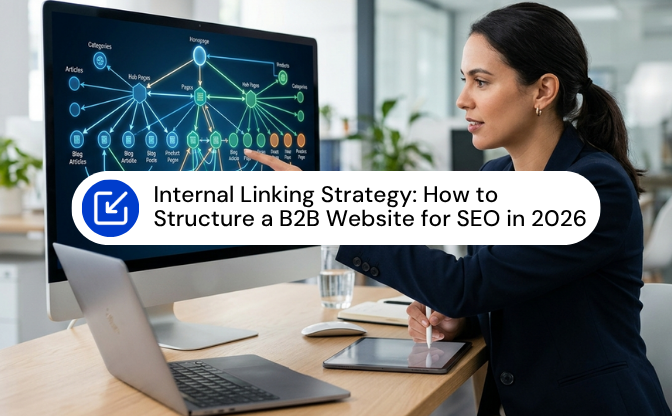
A topic cluster is a group of pages organised around a single broad topic. The cluster has one pillar page (the hub) that covers the topic comprehensively, and multiple cluster pages (the spokes) that each dive deep into a specific sub-topic. Every spoke links back to the hub, and the hub links to every spoke.
Why this architecture works
- It concentrates topical signals into one pillar URL, making it clear to Google and AI engines that this is the authoritative page on the topic.
- It distributes authority from the pillar (which accumulates the most backlinks) to the spokes through internal links.
- It creates a crawl-friendly structure that Googlebot can traverse efficiently.
- It maps naturally to how buyers research: they start broad and go deep.
The B2B cluster model
For a B2B agency like Kerkar Media, a single topic cluster might look like this: the pillar page covers what SEO is and how it works. Cluster pages cover types of SEO, SEO strategy, SEO audits, keyword research, backlinks, and SEO tips. All cluster pages link to the pillar; the pillar links to each cluster. The pillar compounds authority; the cluster pages capture long-tail traffic.
How many clusters should a B2B site have?
A typical B2B site of 50 to 200 pages should have 3 to 8 distinct topic clusters. A larger site of 200 to 1,000 pages might have 10 to 20. Each cluster should be anchored to a commercial intent keyword that maps to your core service offering. Clusters that are purely informational without a commercial anchor rarely compound into revenue.
4. Planning Pillar Pages for B2B
A pillar page is a comprehensive, long-form page that covers a broad topic from multiple angles. It is not a blog post. It is a structured reference that a buyer could use as a complete resource on the topic.
What makes a strong B2B pillar page
- 2,500 to 5,000 words of original, structured content.
- Covers 8 to 12 key aspects of the topic with H2 sections.
- Includes at least one comparison table, one data callout, and one practical framework.
- Links out to every cluster page in the cluster, with contextual anchor text.
- Receives internal links from every cluster page and from 10 plus other relevant pages sitewide.
- Has Article and FAQPage schema deployed.
- Is updated at minimum annually with fresh data and new sections.
B2B pillar page examples by category
- SEO agency: “The Complete Guide to B2B SEO in 2026” (anchors the SEO cluster)
- Manufacturing: “The Manufacturer’s Guide to Industrial Procurement” (anchors the procurement cluster)
- Law firm: “Understanding Commercial Contract Law in India” (anchors the contracts cluster)
- Real estate: “How to Buy Commercial Property in Mumbai: The Developer’s Guide” (anchors the commercial property cluster)
5. Anchor Text Strategy
Anchor text is the visible, clickable text of a link. It is one of the most important on-page signals Google uses to understand what the destination page is about. Getting anchor text right in internal linking is one of the fastest ranking levers a B2B SEO can pull.
The four anchor text types and when to use each
| Anchor Type | Example | When to Use | Frequency |
|---|---|---|---|
| Exact-match | “B2B keyword research” | When you want to send a strong topical signal to the destination | Occasionally: 20-30% of internal links to a page |
| Partial-match | “keyword research for B2B companies” | Natural extensions of the target keyword | Frequently: 30-40% of links |
| Related phrase | “how to find B2B keywords” | Semantic variants that describe the destination | Frequently: 20-30% of links |
| Branded or contextual | “our B2B SEO guide” or “read more about keyword research” | Natural flow, user experience | Occasionally: 10-20% of links |
What to avoid
- “Click here,” “read more,” “learn more”: generic anchors carry no topical signal.
- Exact-match anchor on every internal link to the same page: looks over-optimised.
- Anchors that do not describe the destination: misleads both users and crawlers.
- The same anchor text used for links to multiple different destinations.
6. The Internal Linking Rules That Move Rankings
These are the seven rules we enforce on every B2B site we manage. Each one is testable, and each one has measurably moved rankings within 60 to 90 days when applied to a site that lacked them.
Rule 1: Every new page links to and from at least 3 existing pages before publishing
This is a hard rule in our content workflow. A page that launches with zero internal links pointing to it is nearly invisible. Three contextual internal links from existing, relevant pages is the minimum integration threshold.
Rule 2: Your highest-authority pages link to your highest-priority pages
Authority flows through internal links. Identify your top 10 highest-traffic pages in GA4. Make sure each of them has at least one contextual internal link pointing to each of your top 5 commercial target pages. This is the simplest, fastest ranking intervention on most mid-sized B2B sites.
Rule 3: Every pillar page receives links from every cluster page in its cluster
A pillar page that is not linked to by its own cluster pages is architecturally broken. Run a cluster-completeness check monthly.
Rule 4: Update old posts with links to new content within the first week of publishing
Every new post published should trigger a workflow to add 3 to 5 links from relevant older posts. This both integrates the new content into the site architecture and passes equity to it immediately.
Rule 5: Fix all orphan pages within 30 days of discovery
An orphan page is a page with zero internal inbound links. It should either be integrated (add internal links pointing to it) or removed (if the content is not worth keeping). Never let orphans accumulate.
Rule 6: Do not link from unrelated pages to commercial pages
A contextual internal link from a page about manufacturing SEO to a manufacturing SEO service page is strong. A link from a footer on a completely unrelated page is weak. Relevance is as important as volume.
Rule 7: Audit internal links quarterly
Sites grow, content gets deleted, redirects change. A quarterly audit catches broken internal links, orphan pages, and pages that need more link equity. Monthly lightweight crawls catch regressions between full audits.
Want your B2B site structured for maximum SEO compounding?
Kerkar Media runs internal link audits, cluster-architecture planning, and pillar page builds as part of every technical SEO engagement. A well-structured B2B site compounds faster than any single content investment.
7. Internal Linking and AI Engine Citations
The connection between internal linking and AI-engine citation is one of the clearest 2026 SEO mechanisms, and one of the least discussed.
How AI engines use your internal link structure
When an AI crawler indexes your site, it reads your internal link structure as a topical map. A well-structured cluster tells the AI engine: “this site has deep, interconnected expertise on this topic.” A site with isolated pages and no cluster architecture tells it: “these pages cover random topics loosely.”
AI engines cite topical authorities, not individual keyword-optimised pages. A site where your on-page SEO guide links to your keyword research guide which links to your technical SEO guide which links back to the pillar is a recognisable topical authority. A site where three separate posts on SEO topics have no links between them is not.
The practical implication
Every internal link you add between related pages strengthens the case for your entire site to be cited on that topic. The cluster architecture built for ranking purposes is the same architecture that drives AI citation. This is why our SEO strategy methodology starts with cluster planning before any other work.
8. How to Run an Internal Link Audit
A full internal link audit covers five steps. Run it quarterly; lightweight versions monthly.
Step 1: Full site crawl
Crawl the entire site with Screaming Frog. Export the inlinks report for every URL. This shows you how many internal links point to each page and from which pages.
Step 2: Orphan page detection
Filter the inlinks report to pages with zero internal inbound links. These are orphans. Cross-reference with your sitemap to confirm they are indexed. Triage: integrate or remove.
Step 3: Authority flow check
Identify your 10 highest-traffic pages in GA4. Confirm each has at least one link pointing to each of your top 5 commercial pages. If not, add them.
Step 4: Cluster completeness check
For each defined cluster: does every cluster page link to the pillar? Does the pillar link to every cluster page? Map it in a spreadsheet. Fix gaps.
Step 5: Broken internal link check
In the Screaming Frog crawl, filter to internal links returning 4xx or 3xx status. Fix or redirect every broken internal link. These waste crawl budget and confuse topical signals.
9. Common Internal Linking Mistakes and Fixes
- Publishing new content without integrating it. Fix: add internal link task to every content publishing workflow.
- Linking only from navigation, never from body text. Fix: audit for contextual body-text links; navigation links carry less weight.
- Generic anchor text on every link. Fix: anchor text rewrite pass on pillar pages and high-authority pages.
- Pillar pages not updated when new cluster pages are created. Fix: every new cluster page triggers a pillar page update with a new link.
- Linking to non-canonical URLs in internal links. Fix: all internal links should point to the canonical version (with correct trailing slash, https, and no parameters).
- Footer links to all pages sitewide. Fix: restrict footer links to 10 to 20 highest-priority commercial pages. Global footer links dilute the value of every link.
- No quarterly audit cadence. Fix: schedule a quarterly crawl and internal link review. Most teams do this once and then let it drift for 12 months.
10. B2B Industries That Benefit Most
- Manufacturers with large product and technical content libraries
- Law firms with practice area clusters
- Medical practices with condition and treatment clusters
- Dental clinics with service and FAQ clusters
- Real estate developers with location and property-type clusters
- Restaurants with menu category and location clusters
- Automotive dealers with model and service-type clusters
Key Takeaways
- Internal linking is the most under-used ranking lever in Indian B2B SEO. It moves rankings without new backlinks when done deliberately and consistently.
- Topic clusters (pillar plus cluster pages, all interconnected) are both an SEO architecture and AEO citation infrastructure. Build clusters before anything else.
- Every pillar page should receive 15 to 30 internal inbound links. Every new page must link to and from at least 3 existing pages before launch.
- Anchor text should be descriptive and varied. Exact-match is valuable but should not appear on every link to the same page.
- Orphan pages are a silent ranking killer. Surface them monthly and integrate or remove them within 30 days.
- The cluster architecture that improves rankings also improves AI citation rates. Internal links are the connective tissue of topical authority for both Google and AI engines.
11. Related Reading
For external reading, Google’s guide to crawlable links explains the technical requirements for links Googlebot can follow. Ahrefs’ internal linking guide is the most comprehensive SEO-focused resource available on the topic. Semrush’s internal linking guide approaches it from an on-page audit angle that is useful for implementation. Moz’s internal links explainer covers the foundational theory cleanly. For cluster planning, HubSpot’s pillar page documentation is the origin of the topic-cluster model.
12. Frequently Asked Questions
What is internal linking in SEO?
Internal linking is the practice of linking from one page on your website to another page on the same website. These links serve three purposes: they help search engines crawl and understand your site structure, they pass PageRank from higher-authority pages to priority pages, and they guide users to related content that extends their session.
What is a topic cluster and why does it matter?
A topic cluster is a group of related pages organised around a central pillar page. The pillar covers a broad topic comprehensively, and cluster pages each cover a specific sub-topic in depth. Every cluster page links back to the pillar, and the pillar links to each cluster. This structure signals topical authority to search engines and AI engines, concentrates link equity on the pillar, and maps naturally to how buyers research before purchasing.
How many internal links should each B2B page have?
There is no hard rule, but pillar pages should receive 15 to 30 internal inbound links from across the site. Cluster pages should link to the pillar and 3 to 5 other related pages. Every new page must link to and from at least 3 existing pages before it launches. Focus on quality and relevance over raw count.
What anchor text should I use for internal links?
Use descriptive, varied anchor text. Exact-match anchors (using the exact target keyword) should be used occasionally, making up roughly 20 to 30 percent of all internal links to a given page. A healthy mix includes partial-match, related phrases, and contextual anchors. Avoid generic anchors like “click here” or “read more” and avoid over-using exact-match on every link to the same page.
What are orphan pages and how do I fix them?
Orphan pages are pages with no internal links pointing to them. Search engines can discover them through sitemaps, but without internal links they receive minimal crawl priority and no PageRank from the rest of the site. Fix orphan pages by adding contextually relevant internal links from related pages. Run a Screaming Frog crawl monthly to identify new ones and integrate or remove them within 30 days.
Does internal linking help with AI engine citations?
Yes. Internal links that connect related pages help AI engines understand your topical authority. A well-structured cluster tells AI engines that your site is an authority on the topic, which increases the likelihood of any page in the cluster being cited in AI-generated answers. The cluster architecture built for ranking purposes is the same architecture that drives AEO and GEO citation rates.
How often should I audit my internal links?
Run a lightweight internal link audit monthly using Screaming Frog or a similar crawl tool to catch broken links and new orphan pages. Run a full strategic audit quarterly, covering cluster coverage, pillar strength, anchor text distribution, and authority flow from high-traffic pages to commercial pages. Always audit after adding significant new content or restructuring any section of the site.
Can too many internal links harm SEO?
Yes, if used mechanically in large link dumps rather than contextually in body text. Google recommends keeping the number of links on any single page reasonable and focused. Footer links to every page on the site dilute the value of every link. Focus on contextual links placed naturally in body text. There is no benefit to a page that links to 200 other pages in a navigation widget; the value of each link approaches zero as the count grows.