
 Summarize this Article with AI
Key Highlights
- SEO delivers compounding returns — unlike paid ads, the traffic and authority you build today keeps working for years.
- Small businesses that rank on page one for local search queries capture buyer-intent traffic that no amount of social media posting can replicate.
- The average cost-per-acquisition from organic search is significantly lower than paid channels over a 12-month horizon.
- Local SEO levels the playing field: a well-optimised small business routinely outranks large national brands in city-specific searches.
- An SEO audit is the starting point — it reveals exactly what is holding your website back from ranking and converting.
- Kerkar Media has helped small and medium businesses across India generate consistent organic revenue through structured, long-term SEO strategies.
In This Article
- What Is SEO for Small Business?
- How SEO Works: The Mechanism Behind Organic Growth
- Types of SEO Every Small Business Should Know
- Benefit 1: Sustainable Organic Visibility at Lower Cost
- Benefit 2: Credibility and Trust That Paid Ads Cannot Buy
- Benefit 3: Local SEO Puts You in Front of Nearby Buyers
- Benefit 4: Competing With — and Beating — Larger Brands
- Benefit 5: Industry-Specific SEO That Matches Your Market
- Benefit 6: Content That Educates Buyers and Drives Decisions
- How to Choose the Right SEO Partner for Your Small Business
- Kerkar Media Serves Small Businesses Across India
- Related Reading
- Frequently Asked Questions
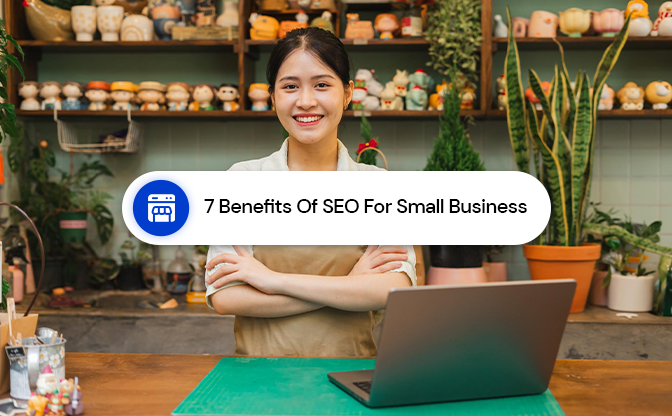
Every small business owner faces the same fundamental problem: customers who need exactly what you offer are searching for it on Google right now — and they are finding your competitors instead of you. That is not a branding problem or a product problem. It is a visibility problem. And SEO is the solution.
The benefits of SEO for small business extend far beyond getting a few more website visitors. Done correctly, search engine optimisation becomes a compounding business asset — one that reduces your cost-per-acquisition, builds genuine authority in your market, and generates leads and sales around the clock without requiring ongoing ad spend. This guide, produced by the team at Kerkar Media, walks through every major benefit with the specificity and data that small business owners deserve.
Whether you run a local service business, a product-based company, a professional practice, or a B2B operation, the principles here apply directly to your growth. If you are ready to understand not just what SEO does but why it is the most important digital marketing investment available to businesses with limited budgets, read on. And if you want to know more about the people behind this guide, visit our About page or check Kerkar Media reviews from businesses we have already helped.
1. What Is SEO for Small Business?
Search engine optimisation is the practice of improving a website’s visibility in organic (non-paid) search results on Google and other search engines. For a small business, this means ensuring that when a potential customer searches for the product or service you offer — in your city, your industry, or your niche — your business appears prominently, ideally on the first page and in the top three results.
Unlike a paid advertising campaign, SEO does not require you to pay per click. The traffic you earn through organic rankings is free in the sense that you do not pay Google each time someone visits your site. You invest in the work — content creation, technical improvements, link building — and that investment generates returns that compound over time. For small businesses operating with tight budgets, this distinction is enormously important.
What Small Business SEO Actually Involves
Small business SEO is not a single tactic — it is a programme that covers technical health (ensuring Google can crawl and index your site efficiently), on-page optimisation (structuring pages with the right keywords, headings, and internal links), off-page authority (building backlinks from credible websites), local signals (Google Business Profile, citations, reviews), and content strategy (producing articles, guides, and landing pages that attract buyers at every stage of the decision journey).
Understanding the scope of these activities is why working with an experienced SEO company — rather than attempting ad-hoc optimisation — consistently produces faster and more durable results. Explore SEO packages built specifically for small and medium businesses to see what a structured engagement looks like.
2. How SEO Works: The Mechanism Behind Organic Growth
Understanding the mechanism behind SEO marketing helps small business owners make better decisions about where to invest and what to expect. Google’s ranking algorithm evaluates several hundred signals to determine which pages best serve a given search query. Three forces dominate: relevance, authority, and experience.
Relevance: Matching Search Intent Precisely
Relevance means your content satisfies what the searcher actually wants. A page that merely contains keywords is not the same as a page that comprehensively answers the question behind those keywords. Identifying the right keywords — the queries your actual customers use at each stage of their decision — begins with rigorous keyword research. This determines not just which terms to target, but which intent to match and which format to use.
Authority: Earning Google’s Trust Through Links
Authority is primarily determined by the quality and relevance of external websites that link to yours. A single backlink from a high-authority publication in your industry is worth far more than dozens of links from unrelated or low-quality directories. Building this authority takes time and genuine effort — which is precisely why it creates a durable competitive moat. Competitors cannot copy your authority overnight.
Experience: Technical Performance That Google Measures
Google’s Core Web Vitals measure page load speed, visual stability, and interactivity. A website that loads slowly, especially on mobile, will not rank regardless of how strong the content is. A thorough SEO audit always begins with technical health — identifying crawl errors, slow pages, broken links, and structural issues that silently suppress rankings.
The compound nature of SEO is its most powerful and least-understood property. Every piece of content you publish, every backlink you earn, and every technical improvement you make builds on the last. A business that begins SEO today will have a structural advantage over a competitor who starts 12 months later — an advantage that widens, not narrows, over time.
3. Types of SEO Every Small Business Should Know
Not all SEO is the same. The types of SEO available span from hyper-local to global in scope, and from technical to creative in method. Understanding which types are most relevant to your business allows you to prioritise effort and budget effectively.
Local SEO
For businesses that serve a specific geographic area — a dentist, a restaurant, a law firm, a plumber — local SEO is the single highest-leverage investment available. It involves Google My Business optimisation, local citations, and location-targeted landing pages. When someone searches “X near me” or “best X in [city]”, local SEO determines whether your business appears in the map pack and the organic results below it.
Technical SEO
Technical SEO ensures that search engines can efficiently discover, crawl, render, and index your website. Without a technically sound foundation, every other SEO effort is compromised. An SEO audit checklist covers the core technical elements that need to be resolved before any other optimisation work begins.
Content SEO and On-Page Optimisation
Content SEO builds topical authority through strategically structured articles, guides, and landing pages. Learning how to write content for local SEO specifically combines geographic targeting with topical relevance — making content that serves both Google and the local customers who will eventually read and act on it.
E-Commerce SEO
Online retailers require a specialised approach to handle product pages, category structures, filtered navigation, and duplicate content at scale. The beginner’s guide to e-commerce SEO covers the fundamentals every product-based business needs to understand before investing in optimisation.
4. Benefit 1: Sustainable Organic Visibility at Lower Cost
The most immediate and tangible benefit of SEO for small business is the ability to generate consistent, qualified website traffic without paying for every click. Google Ads can deliver traffic instantly — but the moment your budget runs out, the traffic stops. SEO traffic, by contrast, continues flowing as long as you maintain and build your rankings.
This distinction has profound implications for small businesses with limited marketing budgets. The cost-per-lead from organic search decreases dramatically over time as rankings stabilise and content continues to attract visitors. A blog post or landing page written today can generate leads for years. No paid campaign has that property.
The Long-Term Asset Value of SEO
Think of SEO as building property rather than renting advertising space. Every piece of optimised content, every earned backlink, every technical improvement adds to an asset you own. This asset grows in value over time and can be one of the most significant contributors to your business’s overall enterprise value — especially for service businesses where customer relationships begin online.
Explore how an SEO agency delivers long-term ROI and why the businesses that begin investing today will have a structural advantage that widens month over month.
5. Benefit 2: Credibility and Trust That Paid Ads Cannot Buy
Consumer psychology consistently shows that organic search results are trusted more than paid advertisements. When your business appears at the top of Google’s organic results for a relevant query, it carries an implicit endorsement — a signal that Google’s algorithm has evaluated your site as the most authoritative and relevant answer available. Paid ads carry no such signal.
This trust translates directly into higher click-through rates, lower bounce rates, and better conversion rates. A visitor who finds you through organic search has already been pre-qualified by the search query they typed. They are actively looking for what you offer. That intent-driven quality of organic traffic is simply not replicable through interruption-based advertising.
Online Reputation as a Ranking Signal
Google increasingly incorporates brand signals — mentions, reviews, press coverage, and social proof — into its assessment of a business’s authority. A strong SEO programme naturally builds and consolidates your online reputation, making your business more visible not just in Google but across the entire digital ecosystem. This is why the importance of digital marketing for small businesses extends well beyond any single channel.
6. Benefit 3: Local SEO Puts You in Front of Nearby Buyers
For the vast majority of small businesses — service providers, retail shops, restaurants, clinics, and professional practices — the most valuable customers are those located nearby who are actively searching for a solution. Local SEO is specifically designed to capture this demand, and it represents one of the most powerful competitive advantages a small business can develop.
When someone searches “best dentist in Bandra” or “accountant near me”, Google returns a map pack alongside organic results. Appearing in both the map pack and the organic listings below it dramatically increases your visibility and click share. Achieving this requires a combination of Google My Business management, consistent local citations, and location-specific content that signals geographic relevance to Google’s algorithm.
Local Content That Drives Foot Traffic and Calls
Writing location-specific content is one of the most effective local SEO tactics available. A page that addresses the specific needs of customers in your city — using local landmarks, area-specific concerns, and community context — ranks for the precise queries your best customers are typing. Understanding how to write content for local SEO is a foundational skill for any small business trying to dominate its geographic market.
7. Benefit 4: Competing With — and Beating — Larger Brands
One of the most counter-intuitive benefits of SEO for small business is that it levels the competitive playing field in a way that no other marketing channel does. In paid advertising, budget wins — a large brand with a massive media spend will consistently outbid you for the same ad placements. In SEO, quality and relevance win. A well-optimised small business website, publishing genuinely useful content and earning credible backlinks, can and regularly does outrank large corporate websites for the keywords that matter most.
Google’s algorithm is specifically designed to reward relevance and authority over size. A local plumber who writes comprehensive, helpful content about plumbing issues in a specific neighbourhood can outrank a national directory for searches that generate real local business. This is one of the most important structural advantages SEO offers to small businesses competing against larger, better-funded competitors.
Niche Targeting: A Small Business’s Hidden Weapon
Large brands target broad, high-volume keywords because their content must serve a national or global audience. Small businesses can go narrow — targeting highly specific, high-intent queries with lower competition that large brands overlook. A manufacturer in Mumbai can rank for extremely specific industrial product queries that national B2B platforms never bother to optimise for, capturing buyers who are deep in the purchase process and ready to convert.
8. Benefit 5: Industry-Specific SEO That Matches Your Market
SEO is not a one-size-fits-all service. Different industries have fundamentally different search landscapes, buyer journeys, and content requirements. One of the most significant benefits of working with a specialist SEO company is access to industry-specific expertise — strategies calibrated to the way your particular customers search, evaluate, and decide.
Healthcare and Medical Practices
Patients search for specific conditions, treatments, and proximity. SEO for doctors and SEO for dentists requires strict attention to YMYL (Your Money or Your Life) content standards, accurate medical information, and strong local signals. A well-optimised practice profile can fill appointment books without spending on paid campaigns.
Legal Practices
Legal search queries carry enormous commercial intent. Someone searching “divorce lawyer in Delhi” or “property dispute attorney Mumbai” is not browsing — they need help now. SEO for law firms focuses on capturing this high-intent, high-value traffic at the precise moment a prospective client is searching for representation.
Real Estate
Property buyers and renters conduct exhaustive online research before making decisions. SEO for real estate agencies and developers means ranking for neighbourhood-specific, property-type-specific, and buyer-stage-specific queries across a buying cycle that can last months.
Restaurants and Food Businesses
Diners consistently use Google to discover restaurants, check reviews, and look up menus. SEO for restaurants combines local SEO, Google Business Profile management, and content strategies — including Instagram marketing for restaurants — to create multiple entry points for hungry, nearby customers.
Automotive Businesses
Whether selling vehicles, offering servicing, or providing parts, automotive businesses depend on high-intent local searches. SEO for the automotive industry targets queries that bring in customers who are actively in the purchase or service cycle — not passive browsers.
Manufacturers and Industrial Businesses
B2B manufacturers face a unique challenge: their buyers are procurement professionals who use highly technical, specific search terms. SEO for manufacturers requires deep keyword research, technical content, and the kind of sustained strategy outlined in SEO tips for manufacturers that most general agencies simply do not understand.
| Industry | Primary SEO Benefit | Key Search Intent | Typical ROI Horizon |
|---|---|---|---|
| Healthcare / Dentistry | Fill appointment slots with local patients | Local + condition-specific | 3 to 5 months |
| Legal Services | Capture high-value, ready-to-hire prospects | High commercial intent | 4 to 8 months |
| Real Estate | Rank for neighbourhood and property queries | Research + transactional | 5 to 9 months |
| Restaurants | Dominate local “near me” and dining searches | Hyper-local + review-driven | 2 to 4 months |
| Automotive | Attract buyers and service customers locally | Local + transactional | 3 to 6 months |
| Manufacturing / B2B | Rank for procurement and technical queries | Informational + B2B intent | 6 to 12 months |
| E-Commerce | Reduce paid dependency, increase organic revenue | Product + comparison intent | 4 to 8 months |
9. Benefit 6: Content That Educates Buyers and Drives Decisions
Content marketing and SEO are not separate disciplines — they are the same discipline. The content you create to rank on Google simultaneously educates your potential customers, addresses their objections, and builds the trust required for them to choose you over a competitor. This dual function makes content SEO one of the most efficient marketing investments available to a small business.
A well-constructed content strategy — informed by keyword research and aligned with the stages of your buyer’s journey — ensures that every piece of content serves a specific commercial purpose. An informational article about a problem your product solves captures early-stage researchers. A comparison page helps mid-funnel evaluators. A service or product landing page converts buyers who are ready to act. Understanding content marketing trends ensures your strategy remains aligned with how modern buyers consume and act on information.
Data-Driven Content for Better Results
The most effective small business content programmes are built on data-driven marketing principles — using real search data to identify what your audience actually wants to read, then creating content that out-performs what already exists. This is precisely the opposite of publishing blog posts on topics you find interesting and hoping they attract customers.
Integrating Social Channels to Amplify Content Reach
Content does not exist in isolation. A social media marketing strategy that systematically distributes your SEO content expands its reach, generates social signals, and can attract backlinks from audiences who discover and share your work. Facebook marketing strategies and LinkedIn marketing are particularly effective for B2B businesses looking to amplify content among professional audiences. Managing this multi-channel activity is made more efficient with the right social media management tools.
10. How to Choose the Right SEO Partner for Your Small Business
The difference between SEO that transforms a small business and SEO that wastes its budget comes down almost entirely to the quality of the partner doing the work. Choosing an SEO agency is one of the most important vendor decisions a small business can make — and the evaluation criteria are more specific than most business owners realise.
What to Look for in an SEO Agency
A credible SEO partner will provide a transparent methodology — not a black-box list of deliverables. They will start with a comprehensive SEO audit of your existing site, produce a strategy document linking their proposed activities to your specific business goals, and report on revenue and lead metrics rather than vanity rankings. They will also have demonstrable experience in what an SEO company actually does — not just in selling packages.
Red Flags to Avoid
Watch for agencies that guarantee specific rankings within a fixed timeframe, offer suspiciously low-cost packages that “include everything”, cannot provide case studies with business outcome data, or rely on link schemes that violate Google’s guidelines. These agencies create short-term improvements and long-term liabilities. The digital marketing landscape has matured to the point where sustainable SEO requires genuine expertise — not shortcuts.
Questions to Ask Before Signing Any Contract
Before committing to an SEO partnership, ask: How do you measure success — by rankings or by revenue? Can you show me examples of businesses similar to mine that you have grown organically? How do you approach technical SEO and content separately? What happens if Google updates its algorithm? How do you build backlinks, and can you show me examples? The answers to these questions will quickly separate strategic agencies from tactical vendors.
The importance of digital marketing for small businesses has never been greater. But the quality of execution matters more than the quantity of tactics. One well-executed SEO strategy, consistently applied over 12 months, will consistently outperform three half-executed strategies across multiple channels.
11. Kerkar Media Serves Small Businesses Across India
Kerkar Media works with small and medium businesses in every major Indian city, delivering SEO programmes calibrated to local search dynamics, industry competition, and specific revenue goals. Whether you need local SEO to dominate a single neighbourhood or a national content strategy to capture buyers across India, our team builds and executes the programme your business requires.
North India
East India
Beyond SEO, Kerkar Media offers a complete range of digital growth services for small businesses: social media marketing, website development, media buying and planning, Amazon marketing, and full-service digital marketing. For businesses wanting to understand how these channels work together before engaging, our digital marketing courses in Mumbai provide the foundational knowledge to make smarter investment decisions.
12. Related Reading
SEO Guides and Resources
- What Is SEO? A Complete Beginner’s Guide
- Types of SEO Explained
- How to Build an Effective SEO Strategy
- The Complete SEO Audit Checklist
- The Importance of Keyword Research for SEO
- What Are Backlinks and Why Do They Matter?
- 25 Actionable SEO Tips to Boost Organic Traffic
- SEO Marketing: The Complete Overview
- How an SEO Agency Delivers Long-Term ROI
- Why an SEO Agency Matters in 2026
Industry SEO Pages
Digital Marketing Resources
About Kerkar Media
Frequently Asked Questions
How long does SEO take to show results for a small business?
Most small businesses begin to see measurable improvements in rankings and organic traffic within 3 to 6 months of consistent SEO work. Competitive industries or newer websites may take 6 to 12 months to see significant revenue impact. Unlike paid ads, the results compound over time — meaning month 12 outperforms month 6 without a proportional increase in spend. Learn more about how an SEO agency delivers long-term ROI.
Is SEO worth it for very small or local businesses?
Yes — local SEO is often the highest-ROI investment available to small and micro businesses. When a potential customer searches for your service in your city, appearing at the top of those results means capturing demand that already exists. There is no outbound persuasion required; the customer has already decided to buy and is simply choosing who to call. Google My Business optimisation is typically the first step for any local business.
How much does SEO cost for a small business?
SEO investment for small businesses in India varies widely depending on the scope, competition, and agency. Kerkar Media offers structured SEO packages designed specifically for small and medium businesses, with transparent deliverables and ROI tracking built in. The best way to get an accurate estimate is to start with a free audit and consultation.
Can a small business do SEO on its own?
Basic on-page SEO — optimising title tags, writing helpful content, and claiming your Google Business Profile — can be done without professional help. However, the technical, competitive, and link-building components require specialist knowledge and tools. A good starting point is reading our guide on 25 actionable SEO tips and understanding how keyword research works before engaging an agency.
What is the difference between SEO and paid search for small businesses?
Paid search (Google Ads) delivers immediate visibility but stops the moment you stop paying. SEO builds organic visibility that persists and compounds. For small businesses with limited budgets, SEO typically delivers a significantly lower cost-per-lead over a 12-to-24-month horizon. Understanding why an SEO agency matters in 2026 explains this distinction in the context of current search behaviour.
Does social media affect SEO for small businesses?
Social media does not directly influence Google rankings, but it drives indirect SEO benefits: greater brand awareness increases branded searches, social shares can generate backlinks, and consistent content distribution builds topical authority. A coordinated social media marketing strategy amplifies the reach of the content your SEO programme produces.
What types of small businesses benefit most from SEO?
Any business whose customers use Google to find products or services benefits from SEO. The highest-impact verticals include healthcare providers, legal firms, restaurants, real estate agencies, automotive businesses, manufacturers, and professional service providers. Kerkar Media has dedicated programmes for doctors, dentists, law firms, real estate, restaurants, and manufacturers.
How do I measure whether SEO is working for my small business?
The primary metrics to track are: organic traffic growth (from Google Search Console and Analytics), keyword ranking improvements for target queries, organic-attributed leads or sales, and cost-per-acquisition from the organic channel. A structured SEO audit at the start of any engagement establishes the baseline against which these metrics are measured.
What is local SEO and why does it matter for small businesses?
Local SEO is the process of optimising your online presence to appear in geographically specific searches — for example, “dentist in Andheri” or “bakery near Connaught Place”. It involves Google Business Profile optimisation, local citations, and location-targeted content. For small businesses serving a specific city or neighbourhood, local SEO directly connects you with nearby customers who are actively looking to buy.
Is SEO a one-time investment or ongoing?
SEO is an ongoing programme, not a one-time project. Google’s algorithm updates frequently, competitors continuously publish new content and build links, and customer search behaviour evolves. Maintaining and building on your rankings requires consistent technical upkeep, content creation, and link acquisition. That said, the compound nature of SEO means each month of effort builds on the last — making it progressively more cost-efficient over time. See how Kerkar Media structures ongoing SEO engagements for small and medium businesses.